Things to Do in Cascais - Top Attractions, Hidden Gems & Must-See Sights

Discover the best things to do in Cascais. Complete guide to must-see sights, popular attractions, hidden gems, museums, food markets and parks.

18 Attractions 4 Categories Travel Guide

Table of Contents

Cascais Overview

Cascais exists at the intersection of aristocratic elegance and the raw power of the Atlantic. Once a retreat for the Portuguese monarchy, the town still feels refined, with grand 19th-century mansions like the Museum of the Counts of Castro Guimarães overlooking quiet coves. You can walk from the sheltered Praia da Rainha to the striking Santa Marta Lighthouse within fifteen minutes.

While the center is walkable, the real drama lies to the west. A short bike ride leads to Boca do Inferno, where the ocean crashes into weathered limestone caves. Further out, the landscape shifts toward the wild dunes of Guincho Beach and the cliffs of Cabo da Roca, the westernmost point of continental Europe.

In the Museum Quarter, the Casa das Histórias Paula Rego balances a relaxed atmosphere with serious cultural weight, offering a quiet alternative to the rugged coast.

Must-See Attractions in Cascais

  • Cabo da Roca — The rugged, wind-swept cliffs marking the westernmost point of continental Europe.
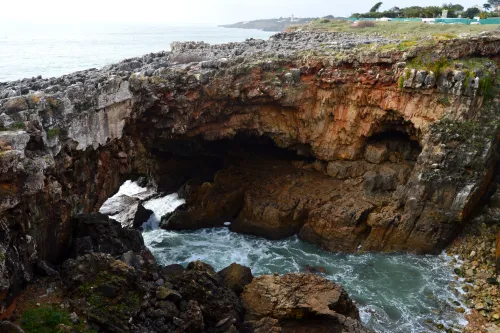
  • Boca do Inferno — A dramatic sea cave where Atlantic swells roar through a natural limestone arch.
  • Guincho Beach — A vast stretch of sand and dunes favored by surfers and those looking for the wild side of the Portuguese coast.
  • Museum of the Counts of Castro Guimarães — An eclectic seaside palace featuring a library of rare books and a tower looking directly over a tidal inlet.
  • Casa das Histórias Paula Rego — A striking contemporary museum dedicated to one of Portugal's greatest artists, known for its twin pyramid-shaped chimneys.
🏛️ Must-See ⭐ Sights 💎 Hidden Gems 🎨 Museums

🏛️ Must-See Attractions in Cascais

These iconic landmarks and must-see sights are essential stops for any visitor to Cascais.

Boca do Inferno

1. Boca do Inferno

Nature turns violent at this chasm in the cliffs, where the Atlantic ocean has carved out a sea arch and a collapsed cave system. The name, which translates to "Hell's Mouth," feels entirely appropriate when winter storms send waves smashing against the limestone with a sound like cannon fire. Even on calmer days, the water churns inside the cauldron, creating a hypnotic spectacle of foam and turquoise depths that draws crowds away from the sheltered bay beaches.

A coastal path connects this spot to the center of town, making it a popular route for walkers and cyclists wanting fresh air. The landscape here is stark and exposed, contrasting sharply with the manicured gardens of the Estoril coast. If you are scouting for dramatic Cascais attractions, the raw power on display here—and the jagged, lunar-like rock formations surrounding the viewing platform—delivers a completely different energy than the swimming coves.

While the viewing platform is safe, the surrounding cliffs are unfenced and slippery. The site also carries a strange literary footprint; the British occultist Aleister Crowley staged a fake suicide here in the 1930s with the help of poet Fernando Pessoa, adding a layer of mystery to the geological drama. It is a place to respect the ocean, watch the fishermen navigating the treacherous rocks below, and listen to the roar of the tides.

Hours Open 24/7
Price Free
Location 38.69104, -9.431
Insider TipVisit at sunset when the tour buses have departed; the light hitting the spray creates rainbows, and the silhouette of the cliffs against the orange sky is the best view in town.
Cabo da Roca

2. Cabo da Roca

Stand at the edge of the continent at this windswept headland, the westernmost point of mainland Europe. The coordinates are marked on a stone monument, but the real draw is the sheer drop into the Atlantic and the feeling of isolation—despite the inevitable crowds. The cliffs rise 140 meters above the sea, exposing layers of granite and syenite that glow pink and grey in the harsh light, topped by a carpet of hardy succulents that manage to survive the constant salt spray.

This is not a place for a leisurely picnic; the wind is relentless and often cold, even in July. However, the raw beauty of the coastline, stretching north toward Sintra and south toward Cascais, is undeniable. Among the most famous Cascais attractions, this one requires some mental preparation for the density of visitors, but if you look past the selfie sticks, the geography itself is humbling. The 18th-century lighthouse still signals to ships navigating one of the busiest maritime corridors in the world.

To truly experience the cape, walk slightly away from the main monument along the trails (staying well back from the unstable edges). The noise of the tourists fades, replaced by the sound of waves crashing far below and the wind tearing through the low vegetation. It is a wild, untamed finale to the Sintra mountain range.

Hours Open 24/7
Price Free
Insider TipSkip the certificate shop and arrive before 10:00 AM or just before sunset to avoid the worst of the bus tour congestion; bring a windbreaker regardless of the forecast.
Guincho Beach

3. Guincho Beach

Leave the calm waters of the town center behind and head north to find the wilder side of the coast. This massive stretch of sand is backed by shifting dunes and framed by the Sintra mountains, facing the full force of the Atlantic. It is famous worldwide for its wind and waves, making it a mecca for kitesurfers and windsurfers, but often a challenge for regular swimmers or sunbathers who hate getting sand blasted into their lunch.

The scenery is cinematic—literally, as it served as a backdrop for a James Bond film. The isolation here is part of the appeal; there are no high-rises, just the road, the boardwalks, and the ocean. When considering outdoor Cascais attractions, this is the choice for walkers and adrenaline junkies rather than families looking for a paddle. The undertow is strong, and the water is consistently cold.

A wooden boardwalk system protects the fragile dune ecosystem and provides a stable walking path along the coast, linking several restaurants known for high-end seafood. It is the perfect place to watch the sunset, as the sun drops directly into the ocean without obstruction. The raw elements here cleanse the palette after the sweetness of the town.

Hours Open 24/7
Price Free
Website Wikipedia
Insider TipIf the wind is too strong for the beach, retreat to 'Bar do Guincho' for a drink; it offers the same spectacular view behind protective glass screens.
Get Your Own Private Tour with AI Guide
AI Guide
  • Personalized tour tailored to your interests
  • Your AI guide tells stories, shares facts, and cracks jokes
  • Turn-by-turn GPS navigation
  • Available in your language — no download needed
Try for Free

💎 Hidden Gems in Cascais - Off the Beaten Path

Beyond the tourist crowds, Cascais hides remarkable treasures waiting to be discovered.

Casa de Santa Maria

1. Casa de Santa Maria

Hugging the coastline next to the blue-and-white lighthouse, this 19th-century private residence turned museum is a masterclass in eclectic luxury. It was built by an Irish aristocrat who wanted a home that celebrated Portuguese craftsmanship, resulting in a layout that feels like a puzzle of beautiful parts. You walk through rooms lined with 17th-century azulejos (tiles) and painted wooden ceilings, with large windows framing the Atlantic ocean crashing against the rocks just meters away.

The house feels intimate, lacking the velvet ropes and barriers of larger palaces. You can imagine the social gatherings of exiled royalty and wealthy industrialists that once took place here. Unlike the modern austerity of the nearby Paula Rego museum, this is one of those Cascais attractions that revels in decoration and history, merging Moorish influences with classic Portuguese style.

It connects internally to the lighthouse courtyard, creating a seamless visit between domestic luxury and maritime utility. The views from the loggia are arguably the best framing of the Santa Marta cove you will find, making it a favorite spot for photographers who want to capture the essence of the Portuguese Riviera without the beach crowds.

Hours Mon: Closed | Tue-Sun: 10:00 AM – 1:00 PM, 2:00 – 6:00 PM
Price 3€
Insider TipBuy the combined ticket that includes the Santa Marta Lighthouse museum next door; the two sites explain the social and maritime history of the same physical space.
Praia da Ursa

2. Praia da Ursa

For those willing to work for their scenery, this is the holy grail of wild beaches. Located just north of Cabo da Roca, it requires a steep, difficult hike down a cliffside trail to reach. The reward is a pristine cove dominated by massive sea stacks (one shaped like a bear, hence the name "Ursa") and absolutely no infrastructure. There are no cafes, no lifeguards, and often, no phone signal.

This is the westernmost beach in Europe, and it feels like the edge of the world. The geology is spectacular, with jagged rocks jutting out of the water like dragon teeth. It is frequently cited in lists of the world's most beautiful beaches, and for once, the hype is justified. Unlike the accessible urban Cascais attractions, this is a wilderness experience.

The water is cold and the currents can be dangerous, so swimming is for the confident only. Many visitors simply go to sit, photograph the formations, and enjoy the raw isolation. It is a place that demands appropriate footwear and water supplies.

Hours Open 24/7
Price Free
Website N/A
Insider TipDo not attempt the descent in flip-flops; the trail is loose gravel and steep. Allow at least 20-30 minutes for the hike back up.
Get Your Own Private Tour with AI Guide
AI Guide
  • Personalized tour tailored to your interests
  • Your AI guide tells stories, shares facts, and cracks jokes
  • Turn-by-turn GPS navigation
  • Available in your language — no download needed
Try for Free

🎨 Best Museums & Galleries in Cascais

World-class museums and galleries that make Cascais a cultural treasure.

Casa das Histórias Paula Rego

1. Casa das Histórias Paula Rego

Two distinctive red concrete pyramids rise above the trees near the Citadel, signaling a museum that is as much an architectural statement as an art repository. Designed by Pritzker Prize-winner Eduardo Souto de Moura, the building houses the works of Paula Rego, one of Portugal's most acclaimed artists. Her paintings and pastels are often unsettling, diving deep into folklore, female psychology, and dark fairy tales, offering a sharp, provocative contrast to the sunny, lighthearted atmosphere of the rest of the town.

Inside, the spaces are cool and reverent, allowing the complex narratives of Rego's art to take center stage. The collection rotates, often pairing her work with that of her late husband, Victor Willing, or other contemporaries. It is a place that demands engagement; you don't just look at these pictures, you solve them. For art lovers ranking Cascais attractions, this is the intellectual heavyweight, providing a necessary counterpoint to the region's resort identity.

The museum also features a garden and a cafeteria that locals actually use, serving excellent light lunches in a quiet setting. The shop is curated with unusual books and prints, avoiding the typical tourist kitsch. Whether you love the architecture or the art, the bold red structure is impossible to ignore and rewarding to explore.

Hours Mon: Closed | Tue-Sun: 10:00 AM – 6:00 PM
Price 8€
Insider TipEntry is often free or very low cost compared to Lisbon museums; check the schedule for guided tours which unlock the often cryptic symbolism in Rego's work.
Centro Cultural de Cascais

2. Centro Cultural de Cascais

Housed in a distinctively pink building that was once a Carmelite convent, the Cultural Center is a major player in the town's art scene. Located just outside the Citadel, it creates a cultural triangle with the Palace and the Paula Rego museum. The renovation preserved the peaceful cloisters and the internal courtyard, making the building itself as interesting as the exhibitions it hosts.

The programming is eclectic, ranging from photography retrospectives and modern sculpture to historical artifacts. Unlike the permanent collections nearby, the displays here change frequently, so it is always worth checking the schedule. Among the various Cascais attractions, this one offers a quiet, contemplative environment, often free from the heavy foot traffic of the main tourist drag.

The venue also hosts classical music concerts and lectures, utilizing the excellent acoustics of the auditorium. It feels like a community hub rather than just a tourist stop, giving you a glimpse into the local appetite for high culture. The contrast between the ancient monastic architecture and the often avant-garde art on the walls is sharp and refreshing.

Hours Mon: Closed | Tue-Sun: 10:00 AM – 6:00 PM
Price 5€
Location 38.694, -9.4211
Insider TipAdmission is often free, and the internal courtyard is one of the few wind-protected sun traps where you can read or rest in complete silence.
Museum of the Counts of Castro Guimarães

3. Museum of the Counts of Castro Guimarães

Looking like a gothic revival castle dropped into a palm-filled park, this museum is the most photogenic building in town. It sits in the Marechal Carmona Park, with its feet almost in the water of a small inlet. Built in 1900, it was the private home of an aristocrat who left it to the town, and walking inside feels like stepping into a time capsule of early 20th-century wealth.

The interior is arranged around a cloister, featuring a stunning library with an organ, Indo-Portuguese furniture, and a kitchen filled with copper pots. It is eclectic, romantic, and slightly eccentric—exactly what a summer palace should be. Among the various Cascais attractions, this one is the most accessible for families, as the surrounding park offers peacocks, roosters, and plenty of shade.

The architecture mixes Manueline (Portuguese gothic) elements with fortress-like towers. The library alone is worth the entry fee, often cited as one of the most beautiful rooms in the country. It captures the fantasy life of the nobility who made this coast their playground.

Hours Mon: Closed | Tue-Sun: 10:00 AM – 1:00 PM, 2:00 – 6:00 PM
Price 5€
Location Maps
Insider TipEntry is usually free on Sundays, but arrive early as the narrow corridors inside the house can get congested with tour groups.
Museum of the Sea

4. Museum of the Sea

Given that the town began as a fishing village and owes its strategic importance to the ocean, this museum is essential for understanding local identity. It is named after King Carlos I, who was a pioneer in oceanography and personally led scientific expeditions in these waters. The collection moves from the biology of the Atlantic to the ethnography of the fishing community, displaying everything from whale skeletons to model boats.

The exhibits are grounded and educational, focusing on the real work of the sea rather than just the scenic beauty. You will see the nets, the traps, and the tragic history of shipwrecks that defined the coast. It is one of the more understated Cascais attractions, lacking the glamour of the art museums, but it provides the grit and the science behind the pretty views.

Located near the Casa das Histórias, it fits easily into a cultural afternoon. The section on deep-sea exploration and the King’s own scientific instruments is particularly surprising, showing a serious academic side to the monarchy that is often overlooked.

Hours Mon: Closed | Tue-Sun: 10:00 AM – 1:00 PM, 2:00 – 6:00 PM
Price 5€
Location 38.6952, -9.4249
Insider TipThis is an excellent rainy-day option for children, as the displays of shells and marine life are visual and accessible without needing to read every placard.
Get Your Own Private Tour with AI Guide
AI Guide
  • Personalized tour tailored to your interests
  • Your AI guide tells stories, shares facts, and cracks jokes
  • Turn-by-turn GPS navigation
  • Available in your language — no download needed
Try for Free

Explore with AI Guide

AI Guide App

Get personalized tours with our AI-powered guide. No download needed — works right in your browser.