Self-Guided Walking Tour in Brussels

11 Stops 4.6 km ~2.5 hours
Start This Tour Free
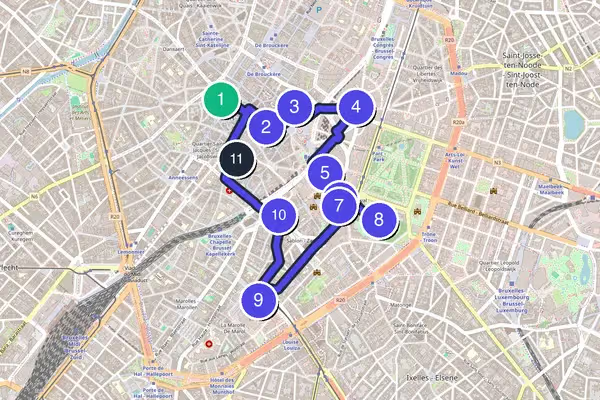
Walking tour route map of Brussels
Start This Tour Free

Why Walk Brussels? A Self-Guided Tour

This self-guided walking tour covers 11 stops across 4.6 km through the historic heart of Brussels, taking roughly 2.5 hours at a comfortable pace. You start at the neoclassical Bourse, loop through the gilded Grand-Place, climb to the royal quarter's museums and palace, descend to the colossal Palais de Justice, and finish at the cheeky Manneken Pis. The route connects the city's grandest squares, its finest Art Nouveau architecture, and its most surreal art collection without ever needing public transport. The ground shifts from rough cobblestones in the lower town to wide paved avenues in the upper city, giving you a physical sense of how Brussels expanded outward over the centuries. Walking this independently beats any guided group tour: you can actually pause at the architecture without someone waving an umbrella in your face.

The Route: 11 Stops

Swipe through images or scroll names below

Scroll to explore →
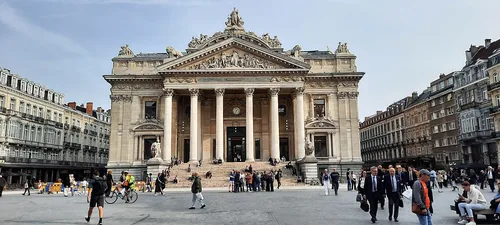
1. Bourse de Bruxelles
2. Grand-Place
3. Royal Galleries of Saint-Hubert
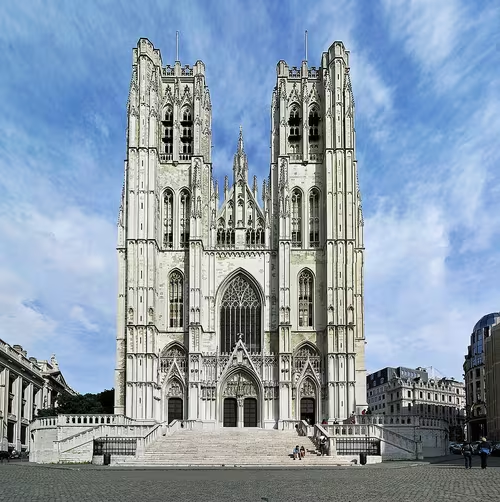
4. Brussels Cathedral
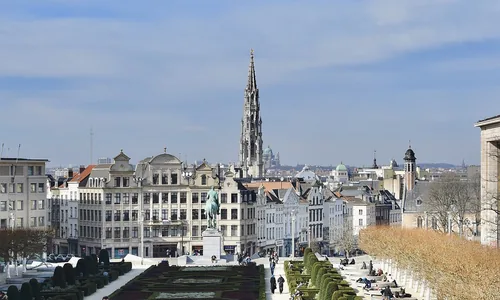
5. Mont des Arts
6. Musical Instrument Museum
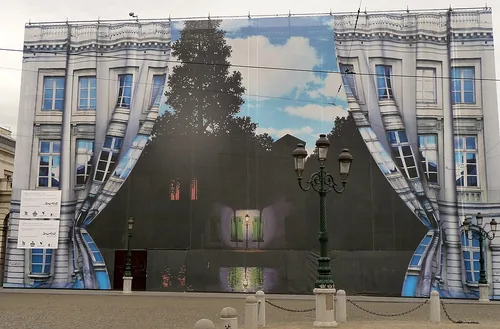
7. Magritte Museum
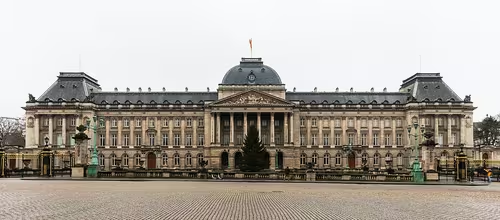
8. Royal Palace of Brussels
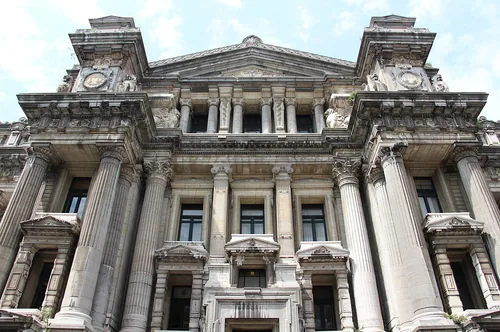
9. Palais de Justice
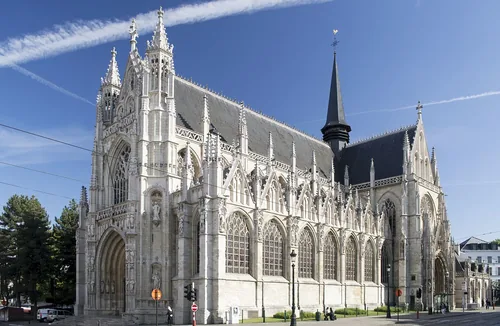
10. Notre-Dame du Sablon
11. Manneken Pis

Route Map

Tap to load interactive map
AI Tourguide
Walk this exact route with a private AI guide.
Full GPS navigation, interactive stories, and a guide that answers all your questions. A private guide experience for just €5/hour.
Start This Tour

Your Brussels Walking Tour, Stop by Stop

  1. 1

    Bourse de Bruxelles

    Bourse de Bruxelles

    The former Brussels Stock Exchange is a muscular neo-Renaissance building completed in 1873 by architect Leon-Pierre Suys, its facade thick with allegorical sculptures by Auguste Rodin's teacher, Albert-Ernest Carrier-Belleuse. Construction crews discovered the ruins of a 13th-century Franciscan monastery beneath the foundations, and those excavated remains are now open to the public as the Bruxella 1238 museum in the basement level. Stand on the wide steps out front for a minute: this is where locals gather on warm evenings, street musicians set up, and the pedestrianized boulevard stretches in both directions. The building no longer trades stocks but hosts rotating exhibitions and cultural events throughout the year.

    Learn more about Bourse de Bruxelles →
    Hours
    Check locally
    Price
    Free (exterior)

    3 min walk

  2. 2

    Grand-Place

    Grand-Place

    Turning the corner onto the Grand-Place genuinely stops you in your tracks, even if you have seen photographs a hundred times. The square measures 68 by 110 meters and is ringed by ornate guild halls rebuilt in just four years after French artillery leveled them in 1695. The 15th-century Town Hall anchors the southwest side with a 96-meter spire topped by a gilded statue of Saint Michael. Come early in the morning before the tour groups arrive and you can appreciate the golden facades in relative peace. Every two years in August, the entire square is carpeted with 600,000 begonias. The square is free and open around the clock. This is one of those places where the reality genuinely matches the hype.

    Learn more about Grand-Place →
    Hours
    Open 24/7
    Price
    Free

    2 min walk

  3. 3

    Royal Galleries of Saint-Hubert

    Royal Galleries of Saint-Hubert

    Step through one of the ornate entrances and you are inside Europe's oldest covered shopping arcade, inaugurated on June 20, 1847, two full decades before Milan's more famous Galleria Vittorio Emanuele II. The glass-vaulted passage stretches 213 meters and is split into three sections: the Queen's Gallery, the King's Gallery, and the Princes' Gallery. Specialized fish-scale glass tiles in the arched roof keep the light even and diffuse. The shops lean toward Belgian chocolate (Neuhaus invented the praline here in 1912), leather goods, and bookshops. Admission is free. Walk the full length slowly and look up: the ironwork and glass ceiling are the real attraction, not the storefronts below them.

    Learn more about Royal Galleries of Saint-Hubert →
    Hours
    Open 24/7
    Price
    Free (shopping arcade)

    4 min walk

  4. 4

    Brussels Cathedral

    Brussels Cathedral

    The Cathedral of St. Michael and St. Gudula sits on a gentle hill above the Galeries, its twin 64-meter towers visible from blocks away. Gothic construction began in 1226, though the towers were not completed until 1485. Inside, the centerpiece is a massive Baroque oak pulpit carved by Hendrik Frans Verbruggen in 1699, depicting Adam and Eve's expulsion from Eden with life-sized figures and carved animals tumbling down the base. The stained glass windows in the transept, designed by Bernard van Orley in the 16th century, are among the finest in Belgium. Entry is free, and the cathedral is open daily from 8:00 AM to 6:00 PM. Give yourself at least ten minutes to appreciate the scale of the nave.

    Learn more about Brussels Cathedral →
    Hours
    Daily: 8:00 AM – 6:00 PM
    Price
    Free

    3 min walk

  5. 5

    Mont des Arts

    Mont des Arts

    King Leopold II demolished an entire medieval neighborhood in 1897 to create this elevated cultural terrace between the upper and lower city. The site sat vacant until a temporary garden was installed for the 1910 World's Fair, and the current formal gardens with geometric fountains were not finished until the 1950s. The resulting viewpoint is one of the best in Brussels: you look straight down to the Town Hall spire rising above the old city rooftops, with the Koekelberg Basilica dome on the horizon. The garden is free and open around the clock. Surrounding the esplanade are the Royal Library, the Cinematek, the Magritte Museum, and several other institutions. This is the spot for the classic Brussels skyline photograph.

    Learn more about Mont des Arts →
    Hours
    Open 24/7
    Price
    Free

    2 min walk

  6. 6

    Musical Instrument Museum

    Musical Instrument Museum

    The MIM occupies the former Old England department store, a spectacular Art Nouveau building designed by Paul Saintenoy and completed in 1899. The collection holds around 7,000 instruments from across centuries and continents, though only about 1,200 are displayed at any time. You are given wireless headphones at entry that automatically play the sound of each instrument as you approach it, turning a static museum into something genuinely immersive. Admission is €10. Open Tuesday through Friday 9:30 AM to 5:00 PM, weekends 10:00 AM to 5:00 PM, closed Mondays. The rooftop restaurant on the top floor has one of the best panoramic views in the city, and you do not need a museum ticket to access it.

    Learn more about Musical Instrument Museum →
    Hours
    Mon: Closed | Tue-Fri: 9:30 AM – 5:00 PM | Sat-Sun: 10:00 AM – 5:00 PM
    Price
    €10

    1 min walk

  7. 7

    Magritte Museum

    Magritte Museum

    Housed in the neoclassical Hotel Altenloh right next door to the MIM, this museum opened in 2009 and holds over 230 original works by Rene Magritte, making it the largest collection of his art anywhere in the world. The 2,500 square meters of gallery space are organized chronologically across three floors, tracing his career from early Impressionist experiments through the iconic bowler-hatted men and floating green apples. Admission is €13 as part of the MRBAB combination ticket covering the adjacent Old Masters and Modern museums as well. Open Tuesday through Friday 10:00 AM to 5:00 PM, weekends 11:00 AM to 6:00 PM, closed Mondays. Budget at least 45 minutes to move through all three floors without rushing.

    Learn more about Magritte Museum →
    Hours
    Mon: Closed | Tue-Fri: 10:00 AM – 5:00 PM | Sat-Sun: 11:00 AM – 6:00 PM
    Price
    €13 (MRBAB combo)

    2 min walk

  8. 8

    Royal Palace of Brussels

    Royal Palace of Brussels

    The official palace of the Belgian monarchy has a facade stretching 113 meters, roughly five meters wider than Buckingham Palace. The current form dates to 1904, though the royal family has not actually lived here since 1831. The interiors are open to the public only during a summer window from July 21 to September 30, Tuesday through Sunday, 10:00 AM to 4:45 PM, and admission during that period is free. The Mirror Room is the highlight: artist Jan Fabre covered the entire ceiling with 1.6 million iridescent Thai jewel beetle wing cases in 2002. Outside the summer opening, you can still admire the imposing facade and the manicured Royal Park across the street.

    Learn more about Royal Palace of Brussels →
    Hours
    Jul 21-Sep 30: Tue-Sun 10am-4:45pm (summer opening only)
    Price
    Free

    5 min walk

  9. 9

    Palais de Justice

    Palais de Justice

    You will see this colossus before you reach it. The Brussels Palace of Justice, completed in 1883 by architect Joseph Poelaert, covers 26,000 square meters of floor space, making it larger than St. Peter's Basilica at the time of its construction. The building sits on the symbolic Gallows Hill, and the demolition of working-class homes to make room for it remains a sore point in local memory. The front steps offer a sweeping panorama across the lower city toward the Atomium and Koekelberg. The interior is a cavernous maze of corridors and courtrooms, and you can walk in during business hours to gaze at the central hall's vertiginous dome. The building has been under perpetual scaffolding for decades.

    Learn more about Palais de Justice →
    Hours
    Mon-Fri: 8:00 AM – 4:00 PM | Sat-Sun: Closed
    Price
    Free

    6 min walk

  10. 10

    Notre-Dame du Sablon

    Notre-Dame du Sablon

    Tucked into the upscale Sablon quarter, this 15th-century church is considered the finest example of Brabantine Gothic architecture in Brussels. The exterior is all flying buttresses and intricate tracery, but the interior is what makes it special: eleven stained-glass windows soar 15 meters high, and when afternoon sunlight hits them, the nave fills with color. There are no entrance fees and no ticket queues. After visiting, step outside to the Place du Grand Sablon, lined with antique dealers and high-end chocolate shops. Pierre Marcolini and Wittamer both have storefronts here. On weekends, an antiques market fills the square with stalls selling vintage prints, silverware, and Art Deco ceramics.

    Learn more about Notre-Dame du Sablon →
    Hours
    Mon-Fri: 10:00 AM – 6:00 PM | Sat-Sun: 9:00 AM – 6:00 PM
    Price
    Free

    5 min walk

  11. 11

    Manneken Pis

    Manneken Pis

    The tour ends at Brussels' most famous and most deliberately underwhelming landmark. Sculptor Jerome Duquesnoy the Elder cast this 55.5-centimeter bronze fountain in 1619 to replace an earlier stone version from 1388. The figure stands at the junction of Rue de l'Etuve and Rue du Chene, and first-time visitors invariably say the same thing: it is much smaller than expected. The real charm is the wardrobe. The statue owns over 1,000 different costumes, and he is dressed in a new outfit several times a week according to a published schedule. The costume collection is displayed in the GardeRobe MannekenPis museum on nearby Rue du Chene. The fountain itself is free to see at any hour.

    Learn more about Manneken Pis →
    Hours
    Open 24/7
    Price
    Free
AI Tourguide
Walk this exact route with a private AI guide.
Full GPS navigation, interactive stories, and a guide that answers all your questions. A private guide experience for just €5/hour.
Start This Tour

Self-Guided Tour vs. Group Tour in Brussels

Brussels packs an unusual amount of variety into a compact center. Within a few hours of walking you move from a medieval market square to Art Nouveau masterpieces to the largest courthouse built in the 19th century, all connected by streets lined with chocolate shops, waffle stands, and comic-strip murals. The city rewards walking more than most capitals because the distances between major sights are short and the side streets are full of surprises. If you only have one day in Brussels, this route covers every essential sight without backtracking.

Group Tour AI Self-Guided
Price €25–€50 per person €5/hour or €20 all-inclusive
Flexibility Fixed schedule Start anytime, skip stops
Languages 1–2 languages 11 languages
Pace Group pace Your own pace

How Long Does This Brussels Tour Take?

Our route covers 4.6 km with 11 stops and takes approximately 2.5 hours at a relaxed pace.

Allow approximately 2.5 hours for the full 4.6 km walk, plus extra time if you plan to enter the Musical Instrument Museum (about 1 hour), the Magritte Museum (45 minutes), or any of the churches. A leisurely pace with a waffle stop and one museum visit will fill a comfortable half-day.

Tips for Walking in Brussels

AI Tourguide
Walk this exact route with a private AI guide.
Full GPS navigation, interactive stories, and a guide that answers all your questions. A private guide experience for just €5/hour.
Start This Tour

AI Audio Guide for This Tour

Follow this 4.6 km Brussels walking tour on your phone with turn-by-turn navigation. The app works offline, so you can walk from the Grand-Place to Manneken Pis without worrying about mobile data.

AI Audio Guide Stories, history and fun facts narrated as you walk. No earpiece rental needed.
GPS Navigation Turn-by-turn directions so you never get lost between stops.
Ask Anything Curious about a building you pass? Ask your AI guide on the spot.
11 Languages Switch language anytime. No separate tour needed.
Start This Tour Free

Common Questions

Yes. All outdoor stops are accessible every day. The Musical Instrument Museum and Magritte Museum are open on weekends with slightly different hours (both open at 10:00 AM on Saturday and Sunday). The only stop affected by day of the week is the Royal Palace interior, which is only open in summer. Weekend mornings also bring the antiques market to the Sablon square, which is a bonus.
Most of the route follows flat, paved streets and is manageable with wheels. The main challenge is the elevation change between the lower city (Grand-Place area) and the upper city (Mont des Arts, Royal Palace). There are elevators in the Mont des Arts area and at the Palais de Justice, but they are not always obvious. The cobblestones around Grand-Place and the Sablon can be bumpy.
Late spring (May to June) and early autumn (September) offer the most comfortable walking weather. Summer has the advantage of the Royal Palace opening its doors for free interior visits from July 21 to September 30. The Flower Carpet on the Grand-Place happens every two years in mid-August and is worth planning around if the timing aligns.
No booking needed. This self-guided tour is available anytime. Open the route on your phone and start walking. The AI audio guide works instantly, no reservation required.
The AI audio guide is available in 11 languages: English, German, French, Spanish, Italian, Japanese, Chinese, Portuguese, Danish, Norwegian, and Swedish.
Yes. Skip any stop, spend extra time at places you like, or start the route from any point. You can also ask the AI to suggest a shorter route.
AI Tourguide
Curated by AI Tourguide GPS-verified routes, reviewed and updated regularly.
Last verified March 2026