Self-Guided Walking Tour in Split

9 Stops 1.1 km ~1.4 hours
Start This Tour Free
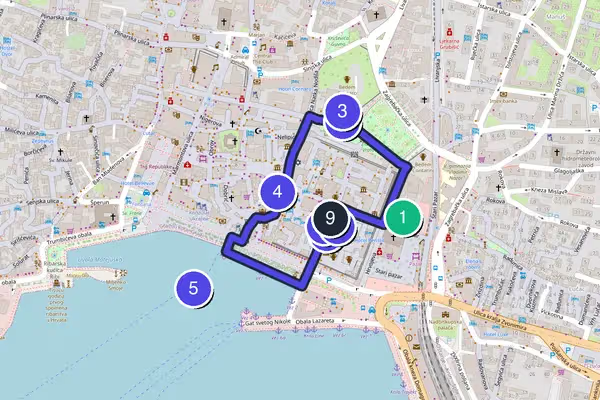
Walking tour route map of Split
Start This Tour Free

Why Walk Split? A Self-Guided Tour

This compact 1.1-kilometer walking tour covers 9 stops inside and around Diocletian's Palace in roughly 1.5 hours. You will walk through the best-preserved Roman imperial residence on earth, a 4th-century complex where 3,000 people still live and work today inside the original walls. The route takes you through ancient gates, medieval squares, a Roman temple, underground cellars, and the oldest Catholic cathedral in the world still in use. Split is not a museum city with roped-off ruins. People drink coffee in 1,700-year-old courtyards, hang laundry from Roman walls, and run restaurants in converted imperial chambers. This walk captures that layered, living quality in under two hours.

The Route: 9 Stops

Swipe through images or scroll names below

Scroll to explore →
1. Silver Gate
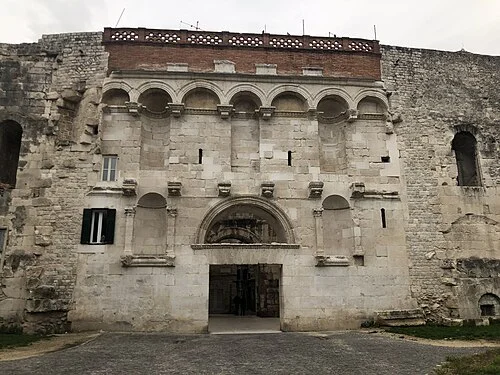
2. Golden Gate
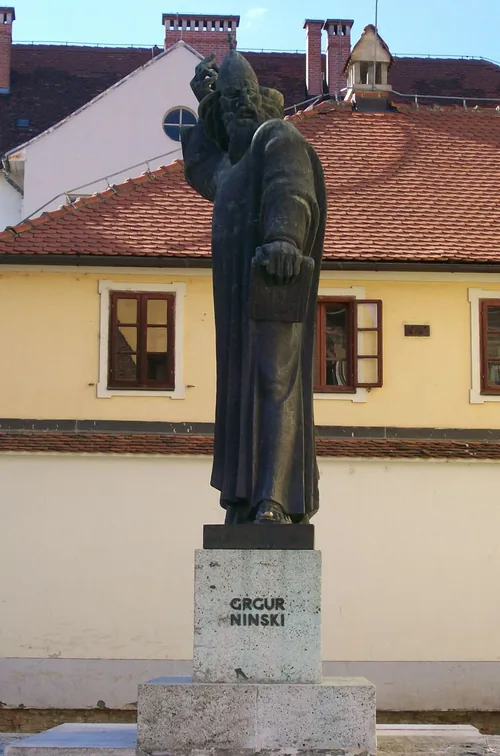
3. Gregory of Nin Statue
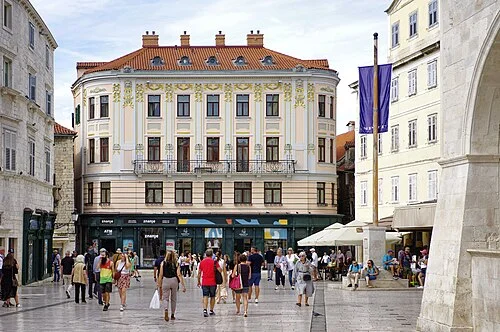
4. People's Square
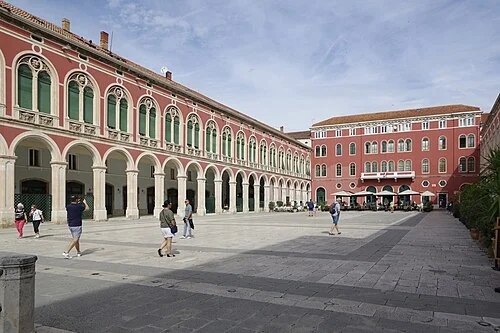
5. Republic Square
6. Temple of Jupiter
7. Diocletian's Cellars
8. Cathedral of Saint Domnius
9. Peristyle Square

Route Map

Tap to load interactive map
AI Tourguide
Walk this exact route with a private AI guide.
Full GPS navigation, interactive stories, and a guide that answers all your questions. A private guide experience for just €5/hour.
Start This Tour

Your Split Walking Tour, Stop by Stop

  1. 1

    Silver Gate

    Silver Gate

    The tour starts at the eastern entrance to Diocletian's Palace, built around 305 AD. The Silver Gate opens directly onto the Pazar, Split's bustling outdoor green market where locals have traded fresh produce since medieval times. Stalls line the palace wall with seasonal fruits, vegetables, dried figs, lavender sachets, and bottles of homemade rakija. Step through the gate and you are immediately inside the palace complex, standing on stones laid for a Roman emperor's retirement residence. The contrast between the ancient stonework and the market chaos just outside sets the tone for the entire walk. The gate is open 24 hours and free to access. Arrive before 9:00 AM if you want to see the market at its busiest without the midday tourist crowds.

    Learn more about Silver Gate →
    Hours
    Open 24/7
    Price
    Free

    2 min walk

  2. 2

    Golden Gate

    Golden Gate

    The most ornate of the four palace gates, the Golden Gate was the emperor's formal entrance, reserved for Diocletian himself. It faces north toward the ancient Roman city of Salona (modern Solin), and the military road that once connected the palace to the provincial capital ran straight through here. The gate's decorative niches originally held statues, now empty, and the stonework above the arch still shows traces of the carved ornamentation that marked this as the most important threshold in the complex. The gate is taller and more imposing than the Silver Gate, with a double entrance that hints at the ceremonial processions it was designed to accommodate. Walk through and look up: the masonry is original 4th-century work, 1,700 years old and still standing.

    Learn more about Golden Gate →
    Hours
    Open 24/7
    Price
    Free

    1 min walk

  3. 3

    Gregory of Nin Statue

    Gregory of Nin Statue

    Just outside the Golden Gate stands Ivan Mestrovic's towering 1929 bronze sculpture of Grgur Ninski, a 10th-century bishop who fought the papacy for the right to conduct church services in the Slavic language rather than Latin. The statue was originally placed in the Peristyle but was moved here during the Italian occupation in World War II. Local tradition says rubbing the statue's left big toe brings good luck, and the toe is polished to a bright gold from decades of hands. Mestrovic is Croatia's most celebrated sculptor, and this is his most popular public work. The statue is outdoors, free, and accessible 24 hours. Take the photo, rub the toe, and turn back south toward the palace interior.

    Learn more about Gregory of Nin Statue →
    Hours
    Open 24/7
    Price
    Free

    3 min walk

  4. 4

    People's Square

    People's Square

    Known locally as Narodni Trg or simply "Pjaca," this square emerged in the 14th century as the first inhabited area of Split outside the palace walls. For centuries it served as the city's administrative center, and the buildings ringing it trace Split's post-Roman evolution. The Romanesque Town Guard building dates from the 15th century and still has its original clock tower. Cafes fill the square today, and it functions as Split's living room: locals meet here before dinner, teenagers gather on the steps, and the evening korzo (promenade) passes through. Sit at one of the outdoor tables, order a macchiato, and watch the square fill up. The architecture around you spans Venetian Gothic, Renaissance, and Baroque periods in a single panoramic sweep.

    Learn more about People's Square →
    Hours
    Open 24/7
    Price
    Free

    2 min walk

  5. 5

    Republic Square

    Republic Square

    Three sides of this large rectangular plaza are enclosed by neo-Renaissance buildings with deep red facades and arched covered walkways, deliberately modeled on Venice's Piazza San Marco. The resemblance is intentional: the square was designed in the mid-19th century when Split was under Austrian rule, and the architects wanted to create a grand public space that evoked Italian elegance. The south side opens directly onto the Riva waterfront promenade with views across the harbor to the islands. On summer evenings, concerts and festivals fill the square. The walkways provide shade on hot days and make this a natural rest point on the route. Free and open 24 hours.

    Learn more about Republic Square →
    Hours
    Free
    Price
    Free

    3 min walk

  6. 6

    Temple of Jupiter

    Temple of Jupiter

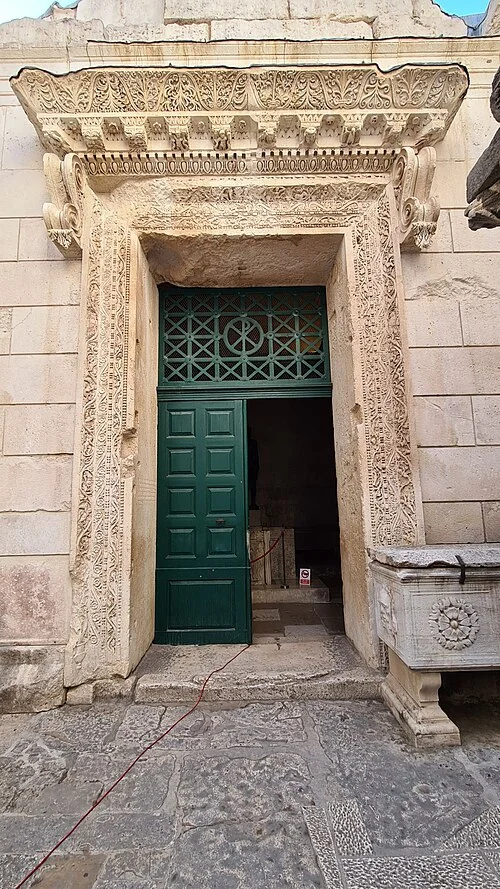
    This small rectangular temple was built by Diocletian for the Roman king of gods and later converted into a Christian baptistery. The barrel-vaulted ceiling inside has survived intact since the 4th century, an astonishing stretch of structural longevity. The carved stone coffering is original Roman work. A headless black granite sphinx, one of several that Diocletian imported from Egypt, guards the entrance. The sphinx dates to the reign of Pharaoh Thutmose III, making it roughly 3,500 years old. The temple is tiny and the interior visit takes less than five minutes, but what you are looking at is genuine Roman religious architecture in its original location, not a reconstruction.

    Learn more about Temple of Jupiter →
    Hours
    Mon-Sat: 8:00 AM – 4:00 PM | Sun: 10:00 AM – 6:00 PM
    Price
    EUR 3

    1 min walk

  7. 7

    Diocletian's Cellars

    Diocletian's Cellars

    The massive underground chambers beneath the palace were not dungeons or storage rooms but the structural foundation for the emperor's private apartments on the floor above. The vaulted halls mirror the layout of the imperial quarters exactly, providing a precise map of rooms that no longer exist at ground level. Centuries of debris filled the cellars until excavations began in the 1950s. Game of Thrones fans will recognize these halls as the setting where Daenerys kept her dragons in Meereen. Today the cellars host rotating exhibitions and a small market selling local crafts. The scale is impressive: the central hall stretches the full width of the southern palace facade.

    Learn more about Diocletian's Cellars →
    Hours
    Open 24/7
    Price
    Free

    1 min walk

  8. 8

    Cathedral of Saint Domnius

    Cathedral of Saint Domnius

    Originally built in 305 AD as Diocletian's octagonal mausoleum, this structure was converted into a Christian cathedral in the 7th century, making it the oldest Catholic cathedral in the world still in continuous use. The irony is sharp: Diocletian was the last Roman emperor to systematically persecute Christians, and his burial chamber is now dedicated to a Christian saint. The Romanesque bell tower, added between the 13th and 16th centuries, offers panoramic views of the palace complex and the harbor from the top. Inside, carved wooden choir stalls from the 13th century and a 15th-century altarpiece fill the intimate octagonal space. Admission is 5 EUR. Open most days from 8:30 AM to 10:00 PM, closed Wednesdays. Climb the bell tower if you have the energy: the view is the best in Split.

    Learn more about Cathedral of Saint Domnius →
    Hours
    Mon-Tue: 8:30 AM – 10:00 PM | Wed: Closed | Thu-Sun: 8:30 AM – 10:00 PM
    Price
    €5

    1 min walk

  9. 9

    Peristyle Square

    Peristyle Square

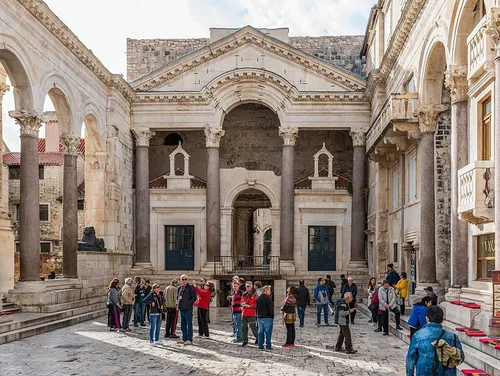
    The tour ends in the ceremonial heart of the palace. This open-air courtyard served as the grand entrance to Diocletian's imperial apartments, and the original Corinthian columns still frame the space on three sides. A 3,500-year-old black granite sphinx from Egypt sits at the base of the steps, one of the few that survived intact from Diocletian's original collection. The Peristyle functions as Split's most atmospheric gathering place: summer opera performances are staged here, tourists sit on the ancient steps with coffee, and the acoustics between the stone walls amplify every conversation. The cathedral rises on the east side, the vestibule (a domed round hall that was the formal entrance to the emperor's quarters) opens to the south. Free and open 24 hours. Sit on the steps, look at the columns, and consider that this courtyard has been a public gathering spot without interruption for 1,700 years.

    Learn more about Peristyle Square →
    Hours
    Open 24/7
    Price
    Free
AI Tourguide
Walk this exact route with a private AI guide.
Full GPS navigation, interactive stories, and a guide that answers all your questions. A private guide experience for just €5/hour.
Start This Tour

Self-Guided Tour vs. Group Tour in Split

Split is not a city where you visit ancient ruins. You walk through them, eat in them, and sit on them. Diocletian's Palace is the only Roman imperial residence where ordinary life has continued unbroken since the 4th century. The entire route fits within a square kilometer, the terrain is flat (with the exception of the cathedral bell tower), and every stop is within a few minutes of the last. No other walk in the Mediterranean packs this much Roman, medieval, and Venetian history into such a small footprint. The palace is free to enter and wander, and the only paid admission on the entire route is the cathedral.

Group Tour AI Self-Guided
Price €25–€50 per person €5/hour or €20 all-inclusive
Flexibility Fixed schedule Start anytime, skip stops
Languages 1–2 languages 11 languages
Pace Group pace Your own pace

How Long Does This Split Tour Take?

Our route covers 1.1 km with 9 stops and takes approximately 1.4 hours at a relaxed pace.

Allow 1.5 to 2 hours for a relaxed pace. The walking distance is just over 1 kilometer, so the time is almost entirely spent at the stops rather than between them. If you climb the cathedral bell tower and linger in the cellars, budget closer to 2.5 hours.

Tips for Walking in Split

AI Tourguide
Walk this exact route with a private AI guide.
Full GPS navigation, interactive stories, and a guide that answers all your questions. A private guide experience for just €5/hour.
Start This Tour

AI Audio Guide for This Tour

Follow this 1.1-kilometer route through Diocletian's Palace with turn-by-turn navigation in the app. All 9 stops are pre-loaded with descriptions, opening hours, and exact locations on the map.

AI Audio Guide Stories, history and fun facts narrated as you walk. No earpiece rental needed.
GPS Navigation Turn-by-turn directions so you never get lost between stops.
Ask Anything Curious about a building you pass? Ask your AI guide on the spot.
11 Languages Switch language anytime. No separate tour needed.
Start This Tour Free

Common Questions

Yes. Walking through the palace streets, gates, Peristyle, and most public spaces is completely free. The only paid attractions on this route are the Cathedral of Saint Domnius (5 EUR) and occasional exhibition tickets in Diocletian's Cellars.
In July and August, the narrow lanes and Peristyle can become very congested between 10:00 AM and 6:00 PM, especially when cruise ships dock. Early morning and evening walks are dramatically quieter. In shoulder season (April to May, September to October), crowds are manageable throughout the day.
Partially. The main palace streets and the Peristyle are accessible on flat ground, but the surfaces are uneven stone. The Temple of Jupiter has steps at the entrance, the cathedral bell tower is only accessible via stairs, and the cellars require descending a staircase. The gates and squares are all step-free.
No booking needed. This self-guided tour is available anytime. Open the route on your phone and start walking. The AI audio guide works instantly, no reservation required.
The AI audio guide is available in 11 languages: English, German, French, Spanish, Italian, Japanese, Chinese, Portuguese, Danish, Norwegian, and Swedish.
Yes. Skip any stop, spend extra time at places you like, or start the route from any point. You can also ask the AI to suggest a shorter route.
AI Tourguide
Curated by AI Tourguide GPS-verified routes, reviewed and updated regularly.
Last verified March 2026